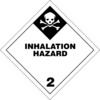
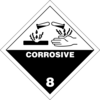
Cyanogen chloride is an inorganic compound with the formula ClCN. This triatomic pseudohalogen is an easily condensed colorless gas. More commonly encountered in the laboratory is the related compound cyanogen bromide, a room-temperature solid that is used in biochemical analysis and preparation. Cyanogen compounds are highly toxic. Wikipedia
×Note: Special provisions may be very complex. The extracts are taken from 49 CFR §172.102. Please be careful with the information, as necessary, additional conditions may be applied that are not written here. Please check the original source and report bugs.
1
This material is poisonous by inhalation (see §171.8) in Hazard Zone A (see §173.116 or §173.133), and must be described as an inhalation hazard under the provisions of this subchapter.
When materials are stabilized by temperature control, the provisions of §173.21 apply. When chemical stabilization is employed, the person offering the material for transport shall ensure that the level of stabilization is sufficient to prevent the material as packaged from dangerous polymerization at 50 °C (122 °F). If chemical stabilization becomes ineffective at lower temperatures within the anticipated duration of transport, temperature control is required in which case transportation is forbidden by aircraft. In making this determination factors to be taken into consideration include, but are not limited to, the capacity and geometry of the packaging and the effect of any insulation present; the temperature of the material when offered for transport; the duration of the journey and the ambient temperature conditions typically encountered in the journey (considering also the season of year); the effectiveness and other properties of the stabilizer employed; applicable operational controls imposed by regulation (e.g., requirements to protect from sources of heat, including other cargo carried at a temperature above ambient); and any other relevant factors.
Stowage category “D” means the material must be stowed “on deck only” on a cargo vessel or on a passenger vessel carrying a number of passengers limited to not more than the larger of 25 passengers or one passenger per each 3 m of overall vessel length, but the material is prohibited on a passenger vessel in which the limiting number of passengers is exceeded.
Segregation chart for load, transport, and storage
This chart shows whether loading, transport, or storage with other hazard classes is permitted, prohibited, or restricted. Based on 49 CFR §177.848.
Note: In this segregation and separation chart are HazMat of hazard class 2.3 considered depending on their poisonousness by inhalation (Hazard zone A). See special provision 1 and PHMSA Interpretation #09-0252.