Fireworks
Fireworks are low explosive pyrotechnic devices used for aesthetic and entertainment purposes. They are most commonly used in fireworks displays (also called a fireworks show or pyrotechnics), combining a large number of devices in an outdoor setting. Such displays are the focal point of many cultural and religious celebrations, though mismanagement can lead to fireworks accidents.
Fireworks take many forms to produce four primary effects: noise, light, smoke, and floating materials (confetti most notably). They may be designed to burn with colored flames and sparks including red, orange, yellow, green, blue, purple and silver. Wikipedia
Data from the Hazardous Materials Table
Source:
49 CFR §172 (2018/07)
(3) Hazard Class 1.4
Explosives |
UN 0336 |
n/a |
 Compatibility group of explosives - Description of substances or article to be classifiedGroup: GPyrotechnic substance or article containing a pyrotechnic substance, or article containing both an explosive substance and an illuminating, incendiary, tear-producing or smoke-producing substance (other than a water-activated article or one containing white phosphorus, phosphide or flammable liquid or gel or hypergolic liquid).
Source: 49 CFR §173.52  |
×Note:Special provisions may be very complex. The extracts are taken from 49 CFR §172.102. Please be careful with the information, as necessary, additional conditions may be applied that are not written here. Please check the original source and report bugs. | 108 | Fireworks must be so constructed and packaged that loose pyrotechnic composition will not be present in packages during transportation. Browse special provision 108 |
|---|
| 200 | Division 1.4G consumer fireworks may be certified for transportation by a DOT-approved Fireworks Certification Agency in accordance with the provisions of §173.65 of this subchapter. Browse special provision 200 |
|---|
|
|
|
| (9A) Passenger aircraft/rail | Forbidden |
|---|
| (9B) Cargo aircraft only | 75 kg |
|---|
|
| (10A) Location | 02 Stowage category “02” means the material may be stowed “on deck” in closed cargo transport units or “under deck” on a cargo vessel (up to 12 passengers) or “on deck” in closed cargo transport units or “under deck” in closed cargo transport units on a passenger vessel. Source: 49 CFR §172.101(k) |
|---|
| (10B) Other | |
|---|
|
(3) Hazard Class 1.3
Explosives |
UN 0335 |
n/a |
 Compatibility group of explosives - Description of substances or article to be classifiedGroup: GPyrotechnic substance or article containing a pyrotechnic substance, or article containing both an explosive substance and an illuminating, incendiary, tear-producing or smoke-producing substance (other than a water-activated article or one containing white phosphorus, phosphide or flammable liquid or gel or hypergolic liquid).
Source: 49 CFR §173.52 |
×Note:Special provisions may be very complex. The extracts are taken from 49 CFR §172.102. Please be careful with the information, as necessary, additional conditions may be applied that are not written here. Please check the original source and report bugs. | 108 | Fireworks must be so constructed and packaged that loose pyrotechnic composition will not be present in packages during transportation. Browse special provision 108 |
|---|
|
|
|
| (9A) Passenger aircraft/rail | Forbidden |
|---|
| (9B) Cargo aircraft only | Forbidden |
|---|
|
| (10A) Location | 03 Stowage category “03” means the material may be stowed “on deck” in closed cargo transport units or “under deck” on a cargo vessel (up to 12 passengers) but the material is prohibited on a passenger vessel. Source: 49 CFR §172.101(k) |
|---|
| (10B) Other | |
|---|
|
(3) Hazard Class 1.2
Explosives |
UN 0334 |
n/a |
 Compatibility group of explosives - Description of substances or article to be classifiedGroup: GPyrotechnic substance or article containing a pyrotechnic substance, or article containing both an explosive substance and an illuminating, incendiary, tear-producing or smoke-producing substance (other than a water-activated article or one containing white phosphorus, phosphide or flammable liquid or gel or hypergolic liquid).
Source: 49 CFR §173.52 |
×Note:Special provisions may be very complex. The extracts are taken from 49 CFR §172.102. Please be careful with the information, as necessary, additional conditions may be applied that are not written here. Please check the original source and report bugs. | 108 | Fireworks must be so constructed and packaged that loose pyrotechnic composition will not be present in packages during transportation. Browse special provision 108 |
|---|
|
|
|
| (9A) Passenger aircraft/rail | Forbidden |
|---|
| (9B) Cargo aircraft only | Forbidden |
|---|
|
| (10A) Location | 03 Stowage category “03” means the material may be stowed “on deck” in closed cargo transport units or “under deck” on a cargo vessel (up to 12 passengers) but the material is prohibited on a passenger vessel. Source: 49 CFR §172.101(k) |
|---|
| (10B) Other | |
|---|
|
(3) Hazard Class 1.1
Explosives |
UN 0333 |
n/a |
 Compatibility group of explosives - Description of substances or article to be classifiedGroup: GPyrotechnic substance or article containing a pyrotechnic substance, or article containing both an explosive substance and an illuminating, incendiary, tear-producing or smoke-producing substance (other than a water-activated article or one containing white phosphorus, phosphide or flammable liquid or gel or hypergolic liquid).
Source: 49 CFR §173.52 |
×Note:Special provisions may be very complex. The extracts are taken from 49 CFR §172.102. Please be careful with the information, as necessary, additional conditions may be applied that are not written here. Please check the original source and report bugs. | 108 | Fireworks must be so constructed and packaged that loose pyrotechnic composition will not be present in packages during transportation. Browse special provision 108 |
|---|
|
|
|
| (9A) Passenger aircraft/rail | Forbidden |
|---|
| (9B) Cargo aircraft only | Forbidden |
|---|
|
| (10A) Location | 03 Stowage category “03” means the material may be stowed “on deck” in closed cargo transport units or “under deck” on a cargo vessel (up to 12 passengers) but the material is prohibited on a passenger vessel. Source: 49 CFR §172.101(k) |
|---|
| (10B) Other | |
|---|
|
(3) Hazard Class 1.4
Explosives |
UN 0337 |
n/a |
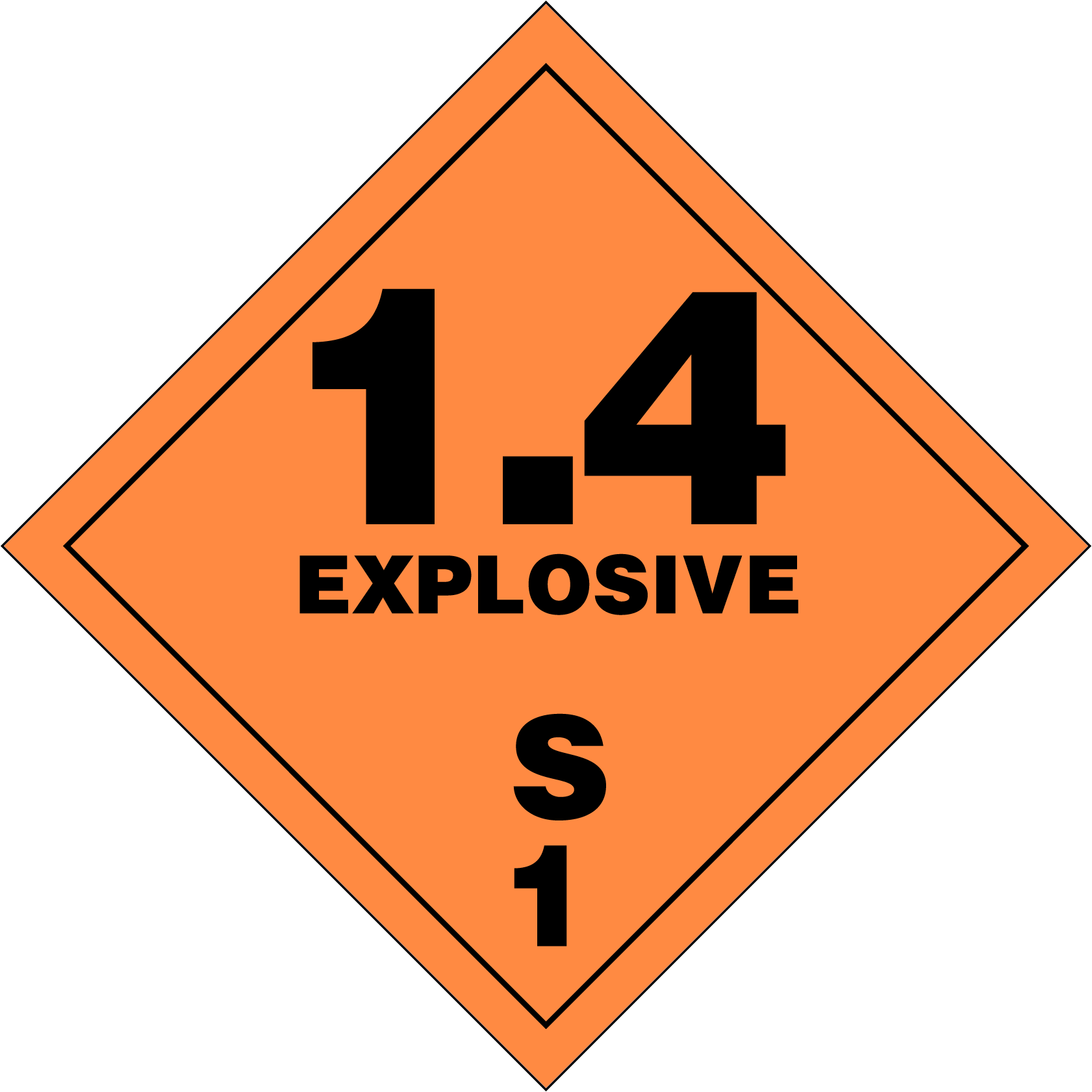 Compatibility group of explosives - Description of substances or article to be classifiedGroup: SSubstance or article so packed or designed that any hazardous effects arising from accidental functioning are limited to the extent that they do not significantly hinder or prohibit fire fighting or other emergency response efforts in the immediate vicinity of the package.
Source: 49 CFR §173.52 |
×Note:Special provisions may be very complex. The extracts are taken from 49 CFR §172.102. Please be careful with the information, as necessary, additional conditions may be applied that are not written here. Please check the original source and report bugs. | 108 | Fireworks must be so constructed and packaged that loose pyrotechnic composition will not be present in packages during transportation. Browse special provision 108 |
|---|
|
|
|
| (9A) Passenger aircraft/rail | 25 kg |
|---|
| (9B) Cargo aircraft only | 100 kg |
|---|
|
| (10A) Location | 01 Stowage category “01” means the material may be stowed “on deck” in closed cargo transport units or “under deck” on a cargo vessel (up to 12 passengers) or on a passenger vessel. Source: 49 CFR §172.101(k) |
|---|
| (10B) Other | |
|---|
|
Comparison View of Different Packing Groups
More than one packing group is indicated for this entry. Criteria for assignment see 49 CFR §173 Subpart D. You can find specific details in the tabs above. Differences are highlighted.
| PG n/a | PG n/a | PG n/a | PG n/a | PG n/a |
|---|
| 1 | | | | | |
| 2 | Fireworks | Fireworks | Fireworks | Fireworks | Fireworks |
| 3 | 1.4G | 1.3G | 1.2G | 1.1G | 1.4S |
| 4 | UN 0336 | UN 0335 | UN 0334 | UN 0333 | UN 0337 |
| 5 | n/a | n/a | n/a | n/a | n/a |
| 6 | 1.4G | 1.3G | 1.2G | 1.1G | 1.4S |
| 7 | 108, 200 | 108 | 108 | 108 | 108 |
| 8A | None | None | None | None | None |
| 8B | 62 | 62 | 62 | 62 | 62 |
| 8C | None | None | None | None | None |
| 9A | Forbidden | Forbidden | Forbidden | Forbidden | 25 kg |
| 9B | 75 kg | Forbidden | Forbidden | Forbidden | 100 kg |
| 10A | 02 | 03 | 03 | 03 | 01 |
| 10B | 25 | 25 | 25 | 25 | 25 |
Segregation Chart for Load, Transport, Storage
In this table a statement is contained for each hazard class whether the loading, transport or storage with other hazard classes is allowed, is not permitted or is restricted. The table is based on U.S.-Code 49 CFR §177.848.
 |
May not be loaded, transported, or stored together in the same transport vehicle or storage facility. |
 |
Load, transport, storage together is not restricted. |
 |
Load, transport, storage together is allowed under restrictions. |
