Information only — not personal consulting. Verify against current official regulations. Help and scope
HazMat Tool — substance information
Reference only — not a shipping paper, placard mandate, or CVI record.
Ethylene oxide and propylene oxide mixtures, with not more than 30 percent ethylene oxide
HMT 15 June 2026
Reference only — HMT snapshot for inspection and audit support; not a shipping paper, placard mandate, or CVI record.
Use Print / PDF below for field notes.
Ethylene oxide and propylene oxide mixtures, with not more than 30 percent ethylene oxide
Ethylene (IUPAC name: ethene) is a hydrocarbon which has the formula C2H4 or H2C=CH2. It is a colourless, flammable gas with a faint "sweet and musky" odour when pure. It is the simplest alkene (a hydrocarbon with carbon–carbon double bonds). Ethylene is widely used in the chemical industry, and its worldwide production (over 225 million tonnes in 2022) exceeds that of any other organic compound Wikipedia
×Note: Special provisions may be very complex. The extracts are taken from 49 CFR §172.102. Please be careful with the information, as necessary, additional conditions may be applied that are not written here. Please check the original source and report bugs.
If this material meets the definition for a material poisonous by inhalation (see § 171.8 of this subchapter), a shipping name must be selected which identifies the inhalation hazard, in Division 2.3 or Division 6.1, as appropriate.
For combination packagings, when metal inner packagings are permitted, only specification cylinders constructed of metals which are compatible with the hazardous material may be used.
a. The maximum degree of filling must not exceed the degree of filling determined by the following:<br><br>Where: <br>t<sub>r</sub> is the maximum mean bulk temperature during transport, <br>t<sub>f</sub> is the temperature in degrees celsius of the liquid during filling, and <br>α is the mean coefficient of cubical expansion of the liquid between the mean temperature of the liquid during filling (t<sub>f</sub>) and the maximum mean bulk temperature during transportation (t<sub>r</sub>) both in degrees celsius. <br>b. For liquids transported under ambient conditions α may be calculated using the formula:<br><br>Where: <br>d<sub>15</sub> and d<sub>50</sub> are the densities (in units of mass per unit volume) of the liquid at 15 °C (59 °F) and 50 °C (122 °F), respectively.
Stowage category “E” means the material may be stowed “on deck” or “under deck” on a cargo vessel or on a passenger vessel carrying a number of passengers limited to not more than the larger of 25 passengers, or one passenger per each 3 m of overall vessel length, but is prohibited from carriage on a passenger vessel in which the limiting number of passengers is exceeded.


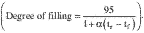 <br>Where: <br>t<sub>r</sub> is the maximum mean bulk temperature during transport, <br>t<sub>f</sub> is the temperature in degrees celsius of the liquid during filling, and <br>α is the mean coefficient of cubical expansion of the liquid between the mean temperature of the liquid during filling (t<sub>f</sub>) and the maximum mean bulk temperature during transportation (t<sub>r</sub>) both in degrees celsius. <br>b. For liquids transported under ambient conditions α may be calculated using the formula:<br>
 <br>Where: <br>d<sub>15</sub> and d<sub>50</sub> are the densities (in units of mass per unit volume) of the liquid at 15 °C (59 °F) and 50 °C (122 °F), respectively.


