Isopropanol or Isopropyl alcohol
Isopropyl alcohol (IUPAC name propan-2-ol and also called isopropanol or 2-propanol, commonly abbreviated as IPA) is a colorless, flammable, organic compound with a pungent odor. Isopropyl alcohol, an organic polar molecule, is miscible in water, ethanol, and chloroform, demonstrating its ability to dissolve a wide range of substances including ethyl cellulose, polyvinyl butyral, oils, alkaloids, and natural resins. Notably, it is not miscible with salt solutions and can be separated by adding sodium chloride in a process known as salting out. It forms an azeotrope with water, resulting in a boiling point of 80.37 °C and is characterized by its slightly bitter taste Wikipedia
Substance Data
Source:
PubChem (HSDB, 05.12.2019)
CAS-Number67-63-0 |
Flash Point— | Boiling Point— |
Hazardous Materials Table
Source:
49 CFR §172 (15 June 2026)
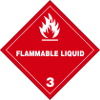
(3) Hazard class 3
Flammable liquids |
UN 1219 |
II |
 |
×Note:Special provisions may be very complex. The extracts are taken from 49 CFR §172.102. Please be careful with the information, as necessary, additional conditions may be applied that are not written here. Please check the original source and report bugs. | IB2 | Authorized IBCs: Metal (31A, 31B and 31N); Rigid plastics (31H1 and 31H2); Composite (31HZ1). Additional Requirement: Only liquids with a vapor pressure less than or equal to 110 kPa at 50 °C (1.1 bar at 122 °F), or 130 kPa at 55 °C (1.3 bar at 131 °F) are authorized. Browse special provision IB2 |
|---|
| T4 | | Minimum test pressure (bar) | 2.65 |
|---|
| Minimum shell thickness | § 178.274(d)(2) |
|---|
| Pressure-relief requirements | Normal |
|---|
| Bottom opening requirements | § 178.275(d)(3) |
|---|
Browse special provision T4 |
|---|
| TP1 | The maximum degree of filling must not exceed the degree of filling determined by the following:  Where: t r is the maximum mean bulk temperature during transport, and t f is the temperature in degrees celsius of the liquid during filling. Browse special provision TP1 |
|---|
|
|
|
| (9A) Passenger aircraft/rail | 5 L |
|---|
| (9B) Cargo aircraft only | 60 L |
|---|
|
| (10A) Location | B Stowage category “B” means - (i) The material may be stowed “on deck” or “under deck” on a cargo vessel and on a passenger vessel carrying a number of passengers limited to not more than the larger of 25 passengers, or one passenger per each 3 m of overall vessel length; and
- (ii) “On deck only” on passenger vessels in which the number of passengers specified in paragraph (k)(2)(i) of this section is exceeded.
Source: 49 CFR §172.101(k) |
|---|
| (10B) Other | — |
|---|
|
Segregation chart for load, transport, and storage
This chart shows whether loading, transport, or storage with other hazard classes is permitted, prohibited, or restricted. Based on 49 CFR §177.848.
 |
Must not be loaded, transported, or stored together in the same vehicle or facility. |
 |
May be loaded, transported, or stored together. |
 |
May be loaded, transported, or stored together only with restrictions. |
