Turpentine
HMT 15 June 2026Turpentine
Turpentine (which is also called spirit of turpentine, oil of turpentine, terebenthine, terebenthene, terebinthine and, colloquially, turps) is a fluid obtainable by the distillation of resin harvested from living trees, mainly pines. Principally used as a specialized solvent, it is also a source of material for organic syntheses. Turpentine is composed of terpenes, primarily the monoterpenes α-pinene and β-pinene, with lesser amounts of carene, camphene, limonene, and terpinolene. Nowadays, turpentine is rarely the product of distillation of pine resin, but is a byproduct of pulping. Pulping is achieved by two processes, the kraft process and the sulfite process Wikipedia
Substance Data
Source: PubChem (HSDB, 21.11.2019)CAS-Number8006-64-2 |
Flash Pointn/a | Boiling Pointn/a |
| Emergency Response Guide No. 128 |
Hazardous Materials Table
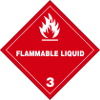
Source: 49 CFR §172 (15 June 2026)(3) Hazard Class3Flammable liquids |
(4) Identification number |
(5) Packing Group |
|||||||||
(6) Labels |
|||||||||||
(7) Special Provisions (§172.102)
|
|||||||||||
| B1 | |
|---|---|
| IB3 | |
| T2 | |
| TP2 | a. The maximum degree of filling must not exceed the degree of filling determined by the following:  Where: tr is the maximum mean bulk temperature during transport, tf is the temperature in degrees celsius of the liquid during filling, and α is the mean coefficient of cubical expansion of the liquid between the mean temperature of the liquid during filling (tf) and the maximum mean bulk temperature during transportation (tr) both in degrees celsius. b. For liquids transported under ambient conditions α may be calculated using the formula:  Where: d15 and d50 are the densities (in units of mass per unit volume) of the liquid at 15 °C (59 °F) and 50 °C (122 °F), respectively. |
(8) Packing Authorizations (§173.***) 
| (8A) Exceptions | 150 | see 49 CFR §173.150 |
|---|---|---|
| (8B) Non-bulk | 203 | see 49 CFR §173.203 |
| (8C) Bulk | 242 | see 49 CFR §173.242 |
(9) Quantity Limits
| (9A) Passenger aircraft/rail | 60 L |
|---|---|
| (9B) Cargo aircraft only | 220 L |
(10) Vessel stowage
| (10A) Location | |
|---|---|
| (10B) Other | n/a |
Segregation chart for load, transport, and storage
This chart shows whether loading, transport, or storage with other hazard classes is permitted, prohibited, or restricted. Based on 49 CFR §177.848.
| Hazard class | 8 | 7 | 6.1 | 5.2 | 5.1 | 4.3 | 4.2 | 4.1 | 3 | 2.3B | 2.3A | 2.2 | 2.1 | 1.6 | 1.5 | 1.4 | 1.3 | 1.1/1.2 |
| 1.1/1.2 |  | | | | | | | | | | | | |  | | | | |
| 1.3 | |  | | | | | | | | | | | | | | | | |
| 1.4 | | | | | | | | | | | | | | | | | ||
| 1.5 | | | | | | | | | | | | | | | | |||
| 1.6 | | | | | | | | | | | | | | | ||||
| 2.1 | | | | | | | | | | | | | | |||||
| 2.2 | | | | | | | | | | | | | ||||||
| 2.3A | | | | | | | | | | | | |||||||
| 2.3B | | | | | | | | | | | ||||||||
| 3 | | | | | | | | | | |||||||||
| 4.1 | | | | | | | | | ||||||||||
| 4.2 | | | | | | | | |||||||||||
| 4.3 | | | | | | | ||||||||||||
| 5.1 | | | | | | |||||||||||||
| 5.2 | | | | | ||||||||||||||
| 6.1 | | | | |||||||||||||||
| 7 | | | ||||||||||||||||
| 8 | |
|
Must not be loaded, transported, or stored together in the same vehicle or facility. |
|
May be loaded, transported, or stored together. |
|
May be loaded, transported, or stored together only with restrictions. |