Thionyl chloride
Thionyl chloride is an inorganic compound with the chemical formula SOCl2. It is a moderately volatile, colourless liquid with an unpleasant acrid odour. Thionyl chloride is primarily used as a chlorinating reagent, with approximately 45,000 tonnes (50,000 short tons) per year being produced during the early 1990s, but is occasionally also used as a solvent. It is toxic, reacts with water, and is also listed under the Chemical Weapons Convention as it may be used for the production of chemical weapons Wikipedia
Substance Data
Source:
PubChem (HSDB, 22.10.2026)
CAS-Number7719-09-7 |
Flash Point— | Boiling Point76 ° C |
Hazardous Materials Table
Source:
49 CFR §172 (15 June 2026)
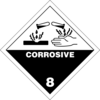
(3) Hazard class 8
Corrosive liquids |
UN 1836 |
I |
 |
×Note:Special provisions may be very complex. The extracts are taken from 49 CFR §172.102. Please be careful with the information, as necessary, additional conditions may be applied that are not written here. Please check the original source and report bugs. | B6 | |
|---|
| B10 | MC 300, MC 301, MC 302, MC 303, MC 305, and MC 306 and DOT 406 cargo tanks, and DOT 57 portable tanks are not authorized. Browse special provision B10 |
|---|
| N34 | Aluminum construction materials are not authorized for any part of a packaging which is normally in contact with the hazardous material. Browse special provision N34 |
|---|
| T10 | <table class="table table-bordered table-condensed ushmr-sp-table"><tr><th>Minimum test pressure (bar)</th><td>4</td></tr><tr><th>Minimum shell thickness</th><td>6 mm</td></tr><tr><th>Pressure-relief requirements</th><td>§ 178.275(g)(3)</td></tr><tr><th>Bottom opening requirements</th><td>Prohibited</td></tr></table> Browse special provision T10 |
|---|
| TP2 | a. The maximum degree of filling must not exceed the degree of filling determined by the following:<br> 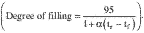 <br>Where: <br>t<sub>r</sub> is the maximum mean bulk temperature during transport, <br>t<sub>f</sub> is the temperature in degrees celsius of the liquid during filling, and <br>α is the mean coefficient of cubical expansion of the liquid between the mean temperature of the liquid during filling (t<sub>f</sub>) and the maximum mean bulk temperature during transportation (t<sub>r</sub>) both in degrees celsius. <br>b. For liquids transported under ambient conditions α may be calculated using the formula:<br>  <br>Where: <br>d<sub>15</sub> and d<sub>50</sub> are the densities (in units of mass per unit volume) of the liquid at 15 °C (59 °F) and 50 °C (122 °F), respectively. Browse special provision TP2 |
|---|
| TP13 | |
|---|
|
|
|
| (9A) Passenger aircraft/rail | Forbidden |
|---|
| (9B) Cargo aircraft only | Forbidden |
|---|
|
| (10A) Location | C Stowage category “C” means the material must be stowed “on deck only” on a cargo vessel or on a passenger vessel. Source: 49 CFR §172.101(k) |
|---|
| (10B) Other | |
|---|
|
Segregation chart for load, transport, and storage
This chart shows whether loading, transport, or storage with other hazard classes is permitted, prohibited, or restricted. Based on 49 CFR §177.848.
Hinweis: In der Kompatibilitätstabelle sind Stoffe der Gefahrenklasse 8 nur dann zu berücksichtigen, wenn der Stoff flüssig ist. Derzeit kann
HazMat Tool nicht prüfen, ob der Stoff flüssig ist. Dies wird daher hier angenommen. Siehe
PHMSA Interpretation #09-0252.
 |
Must not be loaded, transported, or stored together in the same vehicle or facility. |
 |
May be loaded, transported, or stored together. |
 |
May be loaded, transported, or stored together only with restrictions. |
