Information only — not personal consulting. Verify against current official regulations. Help and scope
HazMat Tool — substance information
Reference only — not a shipping paper, placard mandate, or CVI record.
2-(2-Aminoethoxy) ethanol
HMT 15 June 2026
Reference only — HMT snapshot for inspection and audit support; not a shipping paper, placard mandate, or CVI record.
Use Print / PDF below for field notes.
2-Aminoethoxydiphenyl borate (2-APB) is a chemical that acts to inhibit both IP3 receptors and TRP channels (although it activates TRPV1, TRPV2, & TRPV3 at higher concentrations). In research it is used to manipulate intracellular release of calcium ions (Ca2+) and modify TRP channel activity, although the lack of specific effects make it less than ideal under some circumstances. Additionally, there is evidence that 2-APB acts directly to inhibit gap junctions made of connexin. Increasing evidence showed that 2-APB is a powerful modifier of store-operated calcium channels (SOC) function, low concentration of 2-APB can enhance SOC while high concentration induces a transient increase followed by complete inhibition Wikipedia
×Note: Special provisions may be very complex. The extracts are taken from 49 CFR §172.102. Please be careful with the information, as necessary, additional conditions may be applied that are not written here. Please check the original source and report bugs.
<sub>Authorized IBCs:</sub> Metal (31A, 31B and 31N); Rigid plastics (31H1 and 31H2); Composite (31HZ1 and 31HA2, 31HB2, 31HN2, 31HD2 and 31HH2).<br><sub>Additional Requirement:</sub> Only liquids with a vapor pressure less than or equal to 110 kPa at 50 °C (1.1 bar at 122 °F), or 130 kPa at 55 °C (1.3 bar at 131 °F) are authorized, except for UN2672 (also see special provision IP8 in Table 2 for UN2672).
The maximum degree of filling must not exceed the degree of filling determined by the following:<br><br>Where: <br>t<sub>r</sub> is the maximum mean bulk temperature during transport, and t<sub>f</sub> is the temperature in degrees celsius of the liquid during filling.
Segregation chart for load, transport, and storage
This chart shows whether loading, transport, or storage with other hazard classes is permitted, prohibited, or restricted. Based on 49 CFR §177.848.
Hinweis: In der Kompatibilitätstabelle sind Stoffe der Gefahrenklasse 8 nur dann zu berücksichtigen, wenn der Stoff flüssig ist. Derzeit kann HazMat Tool nicht prüfen, ob der Stoff flüssig ist. Dies wird daher hier angenommen. Siehe PHMSA Interpretation #09-0252.
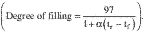 <br>Where: <br>t<sub>r</sub> is the maximum mean bulk temperature during transport, and t<sub>f</sub> is the temperature in degrees celsius of the liquid during filling.


