Information only — not personal consulting. Verify against current official regulations. Help and scope
HazMat Tool — substance information
Reference only — not a shipping paper, placard mandate, or CVI record.
Trifluorochloroethylene, stabilized or Refrigerant gas R 1113
HMT 15 June 2026
Reference only — HMT snapshot for inspection and audit support; not a shipping paper, placard mandate, or CVI record.
Use Print / PDF below for field notes.
Trifluorochloroethylene, stabilized or Refrigerant gas R 1113
Chlorotrifluoroethylene (CTFE) is a chlorofluorocarbon with chemical formula CFCl=CF2. It is commonly used as a refrigerant in cryogenic applications. CTFE has a carbon-carbon double bond and so can be polymerized to form polychlorotrifluoroethylene or copolymerized to produce the plastic ECTFE. PCTFE has the trade name Neoflon PCTFE from Daikin Industries in Japan, and it used to be produced under the trade name Kel-F from 3M Corporation in Minnesota Wikipedia
×Note: Special provisions may be very complex. The extracts are taken from 49 CFR §172.102. Please be careful with the information, as necessary, additional conditions may be applied that are not written here. Please check the original source and report bugs.
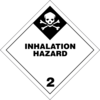
This material is poisonous by inhalation (see § 171.8 of this subchapter) in Hazard Zone C (see § 173.116(a) of this subchapter), and must be described as an inhalation hazard under the provisions of this subchapter.
When materials are stabilized by temperature control, the provisions of § 173.21(f) of this subchapter apply. When chemical stabilization is employed, the person offering the material for transport shall ensure that the level of stabilization is sufficient to prevent the material as packaged from dangerous polymerization at 50 °C (122 °F). If chemical stabilization becomes ineffective at lower temperatures within the anticipated duration of transport, temperature control is required in which case transportation is forbidden by aircraft. In making this determination factors to be taken into consideration include, but are not limited to, the capacity and geometry of the packaging and the effect of any insulation present; the temperature of the material when offered for transport; the duration of the journey and the ambient temperature conditions typically encountered in the journey (considering also the season of year); the effectiveness and other properties of the stabilizer employed; applicable operational controls imposed by regulation (<i>e.g.,</i> requirements to protect from sources of heat, including other cargo carried at a temperature above ambient); and any other relevant factors.
Each bulk packaging, except a tank car or a multi-unit-tank car tank, must be insulated with an insulating material so that the overall thermal conductance at 15.5 °C (60 °F) is no more than 1.5333 kilojoules per hour per square meter per degree Celsius (0.075 Btu per hour per square foot per degree Fahrenheit) temperature differential. Insulating materials must not promote corrosion to steel when wet.
When portable tank instruction T50 is indicated in Column (7) of the § 172.101 Hazardous Materials Table, the applicable liquefied compressed gas and chemical under pressure descriptions are authorized to be transported in portable tanks in accordance with the requirements of § 173.313 of this subchapter.
Stowage category “D” means the material must be stowed “on deck only” on a cargo vessel or on a passenger vessel carrying a number of passengers limited to not more than the larger of 25 passengers or one passenger per each 3 m of overall vessel length, but the material is prohibited on a passenger vessel in which the limiting number of passengers is exceeded.
Segregation chart for load, transport, and storage
This chart shows whether loading, transport, or storage with other hazard classes is permitted, prohibited, or restricted. Based on 49 CFR §177.848.
Hinweis: In der Kompatibilitätstabelle sind Stoffe der Gefahrenklasse 2.3 abhängig der Einstufung der inhalativen Giftigkeit zu berücksichtigen (Gefahrenzone A). Siehe Sonderbestimmung 1 sowie PHMSA Interpretation #09-0252.