Information only — not personal consulting. Verify against current official regulations. Help and scope
HazMat Tool — substance information
Reference only — not a shipping paper, placard mandate, or CVI record.
Phosphorus, white dry or Phosphorus, white, under water or Phosphorus white, in solution or Phosphorus, yellow dry or Phosphorus, yellow, under water or Phosphorus, yellow, in solution
HMT 15 June 2026
Reference only — HMT snapshot for inspection and audit support; not a shipping paper, placard mandate, or CVI record.
Use Print / PDF below for field notes.
Phosphorus, white dry or Phosphorus, white, under water or Phosphorus white, in solution or Phosphorus, yellow dry or Phosphorus, yellow, under water or Phosphorus, yellow, in solution
Phosphorus is a chemical element; it has symbol P and atomic number 15. All elemental forms of phosphorus are highly reactive and are therefore never found in nature. Elemental phosphorus can be prepared artificially, the two most common allotropes being white phosphorus and red phosphorus. With 31P as its only stable isotope, phosphorus has an occurrence in Earth's crust of about 0.1%, generally as phosphate rock Wikipedia
×Note: Special provisions may be very complex. The extracts are taken from 49 CFR §172.102. Please be careful with the information, as necessary, additional conditions may be applied that are not written here. Please check the original source and report bugs.
Tanks must be insulated. Insulation must be at least 100 mm (3.9 inches) except that the insulation thickness may be reduced to 51 mm (2 inches) over the exterior heater coils. Interior heating coils are not authorized. The packaging may not be loaded with a material outside of the packaging's design temperature range. In addition, the material also must be covered with an inert gas or the container must be filled with water to the tank's capacity. After unloading, the residual material also must be covered with an inert gas or the container must be filled with water to the tank's capacity.
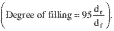
The maximum degree of filling (in %) for solids transported above their melting points and for elevated temperature liquids shall be determined by the following: Where: df and dr are the mean densities of the liquid at the mean temperature of the liquid during filling and the maximum mean bulk temperature during transport respectively.
Stowage category “E” means the material may be stowed “on deck” or “under deck” on a cargo vessel or on a passenger vessel carrying a number of passengers limited to not more than the larger of 25 passengers, or one passenger per each 3 m of overall vessel length, but is prohibited from carriage on a passenger vessel in which the limiting number of passengers is exceeded.