Disinfectant, liquid, corrosive, n.o.s
HMT 15 June 2026Disinfectant, liquid, corrosive, n.o.s
A disinfectant is a chemical substance or compound used to inactivate or destroy microorganisms on inert surfaces. Disinfection does not necessarily kill all microorganisms, especially resistant bacterial spores; it is less effective than sterilization, which is an extreme physical or chemical process that kills all types of life. Disinfectants are generally distinguished from other antimicrobial agents such as antibiotics, which destroy microorganisms within the body, and antiseptics, which destroy microorganisms on living tissue. Disinfectants are also different from biocides Wikipedia
| Emergency Response Guide No. 153 |
Hazardous Materials Table
Source: 49 CFR §172 (15 June 2026)(3) Hazard class8Corrosive liquids |
(4) Identification number |
(5) Packing Group |
||||||||||
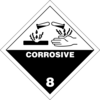
(6) Labels |
||||||||||||
(1) Symbols |
||||||||||||
| A7 | |
|---|---|
| B10 | |
| T14 | |
| TP2 | a. The maximum degree of filling must not exceed the degree of filling determined by the following:  Where: tr is the maximum mean bulk temperature during transport, tf is the temperature in degrees celsius of the liquid during filling, and α is the mean coefficient of cubical expansion of the liquid between the mean temperature of the liquid during filling (tf) and the maximum mean bulk temperature during transportation (tr) both in degrees celsius. b. For liquids transported under ambient conditions α may be calculated using the formula:  Where: d15 and d50 are the densities (in units of mass per unit volume) of the liquid at 15 °C (59 °F) and 50 °C (122 °F), respectively. |
| TP27 |
(8) Packing Authorizations (§173.***) 
| (8A) Exceptions | None | |
|---|---|---|
| (8B) Non-bulk | 201 | see 49 CFR §173.201 |
| (8C) Bulk | 243 | see 49 CFR §173.243 |
(9) Quantity Limits
| (9A) Passenger aircraft/rail | 0.5 L |
|---|---|
| (9B) Cargo aircraft only | 2.5 L |
(10) Vessel stowage
| (10A) Location | |
|---|---|
| (10B) Other | — |
(3) Hazard class8Corrosive liquids |
(4) Identification number |
(5) Packing Group |
|||||||||
(6) Labels |
|||||||||||
(1) Symbols |
|||||||||||
| B2 | |
|---|---|
| IB2 | |
| T7 | |
| TP2 | a. The maximum degree of filling must not exceed the degree of filling determined by the following: Where: tr is the maximum mean bulk temperature during transport, tf is the temperature in degrees celsius of the liquid during filling, and α is the mean coefficient of cubical expansion of the liquid between the mean temperature of the liquid during filling (tf) and the maximum mean bulk temperature during transportation (tr) both in degrees celsius. b. For liquids transported under ambient conditions α may be calculated using the formula: Where: d15 and d50 are the densities (in units of mass per unit volume) of the liquid at 15 °C (59 °F) and 50 °C (122 °F), respectively. |
(8) Packing Authorizations (§173.***)
| (8A) Exceptions | 154 | see 49 CFR §173.154 |
|---|---|---|
| (8B) Non-bulk | 202 | see 49 CFR §173.202 |
| (8C) Bulk | 242 | see 49 CFR §173.242 |
(9) Quantity Limits
| (9A) Passenger aircraft/rail | 1 L |
|---|---|
| (9B) Cargo aircraft only | 30 L |
(10) Vessel stowage
| (10A) Location | |
|---|---|
| (10B) Other | — |
(3) Hazard class8Corrosive liquids |
(4) Identification number |
(5) Packing Group |
|||||||||
(6) Labels |
|||||||||||
(1) Symbols |
|||||||||||
| IB3 | |
|---|---|
| T4 | |
| TP1 | The maximum degree of filling must not exceed the degree of filling determined by the following:  Where: tr is the maximum mean bulk temperature during transport, and tf is the temperature in degrees celsius of the liquid during filling. |
(8) Packing Authorizations (§173.***)
| (8A) Exceptions | 154 | see 49 CFR §173.154 |
|---|---|---|
| (8B) Non-bulk | 203 | see 49 CFR §173.203 |
| (8C) Bulk | 241 | see 49 CFR §173.241 |
(9) Quantity Limits
| (9A) Passenger aircraft/rail | 5 L |
|---|---|
| (9B) Cargo aircraft only | 60 L |
(10) Vessel stowage
| (10A) Location | |
|---|---|
| (10B) Other | — |
Packing group comparison
Multiple packing groups apply to this entry. See assignment criteria in 49 CFR §173 Subpart D. Details are in the tabs above; differences are highlighted.
| PG I | PG II | PG III | |
|---|---|---|---|
| 1 | G | G | G |
| 2 | Disinfectant, liquid, corrosive, n.o.s | Disinfectants, liquid, corrosive n.o.s. | Disinfectants, liquid, corrosive n.o.s. |
| 3 | 8 | 8 | 8 |
| 4 | UN 1903 | UN 1903 | UN 1903 |
| 5 | I | II | III |
| 6 | 8 | 8 | 8 |
| 7 | A7, B10, T14, TP2, TP27 | B2, IB2, T7, TP2 | IB3, T4, TP1 |
| 8A | None | 154 | 154 |
| 8B | 201 | 202 | 203 |
| 8C | 243 | 242 | 241 |
| 9A | 0.5 L | 1 L | 5 L |
| 9B | 2.5 L | 30 L | 60 L |
| 10A | B | B | A |
| 10B | — | — | — |
Segregation chart for load, transport, and storage
This chart shows whether loading, transport, or storage with other hazard classes is permitted, prohibited, or restricted. Based on 49 CFR §177.848.
| Hazard class | 8 | 7 | 6.1 | 5.2 | 5.1 | 4.3 | 4.2 | 4.1 | 3 | 2.3B | 2.3A | 2.2 | 2.1 | 1.6 | 1.5 | 1.4 | 1.3 | 1.1/1.2 |
| 1.1/1.2 |  | | | | | | | | | | | | |  | | | | |
| 1.3 | |  | | | | | | | | | | | | | | | | |
| 1.4 | | | | | | | | | | | | | | | | | ||
| 1.5 | | | | | | | | | | | | | | | | |||
| 1.6 | | | | | | | | | | | | | | | ||||
| 2.1 | | | | | | | | | | | | | | |||||
| 2.2 | | | | | | | | | | | | | ||||||
| 2.3A | | | | | | | | | | | | |||||||
| 2.3B | | | | | | | | | | | ||||||||
| 3 | | | | | | | | | | |||||||||
| 4.1 | | | | | | | | | ||||||||||
| 4.2 | | | | | | | | |||||||||||
| 4.3 | | | | | | | ||||||||||||
| 5.1 | | | | | | |||||||||||||
| 5.2 | | | | | ||||||||||||||
| 6.1 | | | | |||||||||||||||
| 7 | | | ||||||||||||||||
| 8 | |
|
Must not be loaded, transported, or stored together in the same vehicle or facility. |
|
May be loaded, transported, or stored together. |
|
May be loaded, transported, or stored together only with restrictions. |
Similar substances
| UN / ID | Proper shipping name | Hazard class |
|---|---|---|
| UN 1903 | Disinfectant, liquid, corrosive, n.o.s | 8 |
| UN 3142 | Disinfectants, liquid, toxic, n.o.s. | 6.1 |
| UN 1601 | Disinfectants, solid, toxic, n.o.s. | 6.1 |