Organometallic substance, liquid, water-reactive
HMT 15 June 2026
Reference only — HMT snapshot for inspection and audit support; not a shipping paper, placard mandate, or CVI record.
Use Print / PDF below for field notes.
- UN / ID
- UN 3398
- Hazard class
- 4.3
- Packing group
- I (multiple — see tabs)
- ERG guide
- ERG 135
- Special provisions
- SP T13, SP TP2, SP TP7, SP TP36, SP TP47, SP W31
- Source
- 49 CFR §172 (15 June 2026)
Spot an error in this entry?
Organometallic substance, liquid, water-reactive
Organometallic chemistry is the study of organometallic compounds, chemical compounds containing at least one chemical bond between a carbon atom of an organic molecule and a metal, including alkali, alkaline earth, and transition metals, and sometimes broadened to include metalloids like boron, silicon, and selenium, as well. Aside from bonds to organyl fragments or molecules, bonds to 'inorganic' carbon, like carbon monoxide (metal carbonyls), cyanide, or carbide, are generally considered to be organometallic as well. Some related compounds such as transition metal hydrides and metal phosphine complexes are often included in discussions of organometallic compounds, though strictly speaking, they are not necessarily organometallic. The related but distinct term "metalorganic compound" refers to metal-containing compounds lacking direct metal-carbon bonds but which contain organic ligands Wikipedia
Hazardous Materials Table
Source:
49 CFR §172 (15 June 2026)
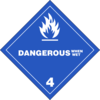
(3) Hazard class 4.3
Dangerous when wet materials |
UN 3398 |
I |
  |
This entry is signed with "G". The letter "G" identifies proper shipping names for which one or more technical names of the hazardous material must be entered in parentheses, in association with the basic description. (See §172.203(k)).
×Note:Special provisions may be very complex. The extracts are taken from 49 CFR §172.102. Please be careful with the information, as necessary, additional conditions may be applied that are not written here. Please check the original source and report bugs. | T13 | | Minimum test pressure (bar) | 6 |
|---|
| Minimum shell thickness | 6 mm |
|---|
| Pressure-relief requirements | Normal |
|---|
| Bottom opening requirements | Prohibited |
|---|
Browse special provision T13 |
|---|
| TP2 | a. The maximum degree of filling must not exceed the degree of filling determined by the following:  Where: t r is the maximum mean bulk temperature during transport, t f is the temperature in degrees celsius of the liquid during filling, and α is the mean coefficient of cubical expansion of the liquid between the mean temperature of the liquid during filling (t f) and the maximum mean bulk temperature during transportation (t r) both in degrees celsius. b. For liquids transported under ambient conditions α may be calculated using the formula:  Where: d 15 and d 50 are the densities (in units of mass per unit volume) of the liquid at 15 °C (59 °F) and 50 °C (122 °F), respectively. Browse special provision TP2 |
|---|
| TP7 | |
|---|
| TP36 | For material assigned this portable tank special provision, portable tanks used to transport such material may be equipped with fusible elements in the vapor space of the portable tank. Browse special provision TP36 |
|---|
| TP47 | The 2.5 year internal examination may be waived or substituted by other test methods or inspection procedures specified by the competent authority or its authorized body, provided that the portable tank is dedicated to the transport of the organometallic substances to which this tank special provision is assigned. However this examination is required when the conditions of § 180.605(f) are met. Browse special provision TP47 |
|---|
| W31 | |
|---|
|
|
|
| (9A) Passenger aircraft/rail | Forbidden |
|---|
| (9B) Cargo aircraft only | 1 L |
|---|
|
| (10A) Location | D Stowage category “D” means the material must be stowed “on deck only” on a cargo vessel or on a passenger vessel carrying a number of passengers limited to not more than the larger of 25 passengers or one passenger per each 3 m of overall vessel length, but the material is prohibited on a passenger vessel in which the limiting number of passengers is exceeded. Source: 49 CFR §172.101(k) |
|---|
| (10B) Other | |
|---|
|
(3) Hazard class 4.3
Dangerous when wet materials |
UN 3398 |
II |
| |
This entry is signed with "G". The letter "G" identifies proper shipping names for which one or more technical names of the hazardous material must be entered in parentheses, in association with the basic description. (See §172.203(k)).
×Note:Special provisions may be very complex. The extracts are taken from 49 CFR §172.102. Please be careful with the information, as necessary, additional conditions may be applied that are not written here. Please check the original source and report bugs. | IB1 | Authorized IBCs: Metal (31A, 31B and 31N). Additional Requirement: Only liquids with a vapor pressure less than or equal to 110 kPa at 50 °C (1.1 bar at 122 °F), or 130 kPa at 55 °C (1.3 bar at 131 °F) are authorized. Browse special provision IB1 |
|---|
| IP2 | When IBCs other than metal or rigid plastics IBCs are used, they must be offered for transportation in a closed freight container or a closed transport vehicle. Browse special provision IP2 |
|---|
| T7 | | Minimum test pressure (bar) | 4 |
|---|
| Minimum shell thickness | § 178.274(d)(2) |
|---|
| Pressure-relief requirements | Normal |
|---|
| Bottom opening requirements | § 178.275(d)(3) |
|---|
Browse special provision T7 |
|---|
| TP2 | a. The maximum degree of filling must not exceed the degree of filling determined by the following: Where: t r is the maximum mean bulk temperature during transport, t f is the temperature in degrees celsius of the liquid during filling, and α is the mean coefficient of cubical expansion of the liquid between the mean temperature of the liquid during filling (t f) and the maximum mean bulk temperature during transportation (t r) both in degrees celsius. b. For liquids transported under ambient conditions α may be calculated using the formula: Where: d 15 and d 50 are the densities (in units of mass per unit volume) of the liquid at 15 °C (59 °F) and 50 °C (122 °F), respectively. Browse special provision TP2 |
|---|
| TP7 | |
|---|
| TP36 | For material assigned this portable tank special provision, portable tanks used to transport such material may be equipped with fusible elements in the vapor space of the portable tank. Browse special provision TP36 |
|---|
| TP47 | The 2.5 year internal examination may be waived or substituted by other test methods or inspection procedures specified by the competent authority or its authorized body, provided that the portable tank is dedicated to the transport of the organometallic substances to which this tank special provision is assigned. However this examination is required when the conditions of § 180.605(f) are met. Browse special provision TP47 |
|---|
| W31 | |
|---|
|
|
|
| (9A) Passenger aircraft/rail | 1 L |
|---|
| (9B) Cargo aircraft only | 5 L |
|---|
|
| (10A) Location | D Stowage category “D” means the material must be stowed “on deck only” on a cargo vessel or on a passenger vessel carrying a number of passengers limited to not more than the larger of 25 passengers or one passenger per each 3 m of overall vessel length, but the material is prohibited on a passenger vessel in which the limiting number of passengers is exceeded. Source: 49 CFR §172.101(k) |
|---|
| (10B) Other | |
|---|
|
(3) Hazard class 4.3
Dangerous when wet materials |
UN 3398 |
III |
| |
This entry is signed with "G". The letter "G" identifies proper shipping names for which one or more technical names of the hazardous material must be entered in parentheses, in association with the basic description. (See §172.203(k)).
×Note:Special provisions may be very complex. The extracts are taken from 49 CFR §172.102. Please be careful with the information, as necessary, additional conditions may be applied that are not written here. Please check the original source and report bugs. | IB2 | Authorized IBCs: Metal (31A, 31B and 31N); Rigid plastics (31H1 and 31H2); Composite (31HZ1). Additional Requirement: Only liquids with a vapor pressure less than or equal to 110 kPa at 50 °C (1.1 bar at 122 °F), or 130 kPa at 55 °C (1.3 bar at 131 °F) are authorized. Browse special provision IB2 |
|---|
| IP4 | Flexible, fiberboard or wooden IBCs must be sift-proof and water-resistant or be fitted with a sift-proof and water-resistant liner. Browse special provision IP4 |
|---|
| T7 | | Minimum test pressure (bar) | 4 |
|---|
| Minimum shell thickness | § 178.274(d)(2) |
|---|
| Pressure-relief requirements | Normal |
|---|
| Bottom opening requirements | § 178.275(d)(3) |
|---|
Browse special provision T7 |
|---|
| TP2 | a. The maximum degree of filling must not exceed the degree of filling determined by the following: Where: t r is the maximum mean bulk temperature during transport, t f is the temperature in degrees celsius of the liquid during filling, and α is the mean coefficient of cubical expansion of the liquid between the mean temperature of the liquid during filling (t f) and the maximum mean bulk temperature during transportation (t r) both in degrees celsius. b. For liquids transported under ambient conditions α may be calculated using the formula: Where: d 15 and d 50 are the densities (in units of mass per unit volume) of the liquid at 15 °C (59 °F) and 50 °C (122 °F), respectively. Browse special provision TP2 |
|---|
| TP7 | |
|---|
| TP36 | For material assigned this portable tank special provision, portable tanks used to transport such material may be equipped with fusible elements in the vapor space of the portable tank. Browse special provision TP36 |
|---|
| TP47 | The 2.5 year internal examination may be waived or substituted by other test methods or inspection procedures specified by the competent authority or its authorized body, provided that the portable tank is dedicated to the transport of the organometallic substances to which this tank special provision is assigned. However this examination is required when the conditions of § 180.605(f) are met. Browse special provision TP47 |
|---|
| W31 | |
|---|
|
|
|
| (9A) Passenger aircraft/rail | 5 L |
|---|
| (9B) Cargo aircraft only | 60 L |
|---|
|
| (10A) Location | E Stowage category “E” means the material may be stowed “on deck” or “under deck” on a cargo vessel or on a passenger vessel carrying a number of passengers limited to not more than the larger of 25 passengers, or one passenger per each 3 m of overall vessel length, but is prohibited from carriage on a passenger vessel in which the limiting number of passengers is exceeded. Source: 49 CFR §172.101(k) |
|---|
| (10B) Other | |
|---|
|
Packing group comparison
Multiple packing groups apply to this entry. See assignment criteria in 49 CFR §173 Subpart D. Details are in the tabs above; differences are highlighted.
| PG I | PG II | PG III |
|---|
| 1 | G | G | G |
| 2 | Organometallic substance, liquid, water-reactive | Organometallic substance, liquid, water-reactive | Organometallic substance, liquid, water-reactive |
| 3 | 4.3 | 4.3 | 4.3 |
| 4 | UN 3398 | UN 3398 | UN 3398 |
| 5 | I | II | III |
| 6 | 4.3 | 4.3 | 4.3 |
| 7 | T13, TP2, TP7, TP36, TP47, W31 | IB1, IP2, T7, TP2, TP7, TP36, TP47, W31 | IB2, IP4, T7, TP2, TP7, TP36, TP47, W31 |
| 8A | None | 151 | 151 |
| 8B | 201 | 202 | 203 |
| 8C | 244 | 243 | 242 |
| 9A | Forbidden | 1 L | 5 L |
| 9B | 1 L | 5 L | 60 L |
| 10A | D | D | E |
| 10B | 13, 40, 52, 148 | 13, 40, 52, 148 | 13, 40, 52, 148 |
Segregation chart for load, transport, and storage
This chart shows whether loading, transport, or storage with other hazard classes is permitted, prohibited, or restricted. Based on 49 CFR §177.848.
 |
Must not be loaded, transported, or stored together in the same vehicle or facility. |
 |
May be loaded, transported, or stored together. |
 |
May be loaded, transported, or stored together only with restrictions. |
Similar substances
| UN / ID | Proper shipping name | Hazard class |
|---|
| UN 3399 | Organometallic substance, liquid, water-reactive, flammable | 4.3 |
| UN 3396 | Organometallic substance, solid, water-reactive, flammable | 4.3 |
| UN 3397 | Organometallic substance, solid, water-reactive, self-heating | 4.3 |
| UN 3394 | Organometallic substance, liquid, pyrophoric, water-reactive | 4.2 |
| UN 3393 | Organometallic substance, solid, pyrophoric, water-reactive | 4.2 |
| UN 3395 | Organometallic substance, solid, water-reactive | 4.3 |
| UN 3392 | Organometallic substance, liquid, pyrophoric | 4.2 |
| UN 3282 | Organometallic compound, liquid, toxic, n.o.s | 6.1 |
| UN 3391 | Organometallic substance, solid, pyrophoric | 4.2 |
| UN 3400 | Organometallic substance, solid, self-heating | 4.2 |
| UN 3467 | Organometallic compound, solid, toxic, n.o.s | 6.1 |
