Solids containing corrosive liquid, n.o.s.
Solid is a state of matter in which atoms are closely packed and are difficult to move past each other. Solids resist compression, expansion, or external forces that would alter its shape, with the degree of resistance being dependent upon the specific material under consideration. Solids also always possess the least kinetic energy per atom/molecule relative to other phases or, equivalently stated, solids are formed when matter in the liquid / gas phase is cooled below a certain temperature. This temperature is called the melting point of the substance and is an intrinsic property; i.e Wikipedia
Hazardous Materials Table
Source:
49 CFR §172 (15 June 2026)
(3) Hazard class 8
Corrosive liquids |
UN 3244 |
II |
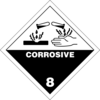 |
This entry is signed with "G". The letter "G" identifies proper shipping names for which one or more technical names of the hazardous material must be entered in parentheses, in association with the basic description. (See §172.203(k)).
×Note:Special provisions may be very complex. The extracts are taken from 49 CFR §172.102. Please be careful with the information, as necessary, additional conditions may be applied that are not written here. Please check the original source and report bugs. | 49 | Mixtures of solids that are not subject to this subchapter and corrosive liquids may be transported under this entry without first applying the classification criteria of Class 8, provided there is no free liquid visible at the time the material is loaded or at the time the packaging or transport unit is closed. For single packagings, each packaging must correspond to a design type that has passed a leakproofness test at the Packing Group II level. Browse special provision 49 |
|---|
| IB5 | <sub>Authorized IBCs:</sub> Metal (11A, 11B, 11N, 21A, 21B, 21N, 31A, 31B and 31N); Rigid plastics (11H1, 11H2, 21H1, 21H2, 31H1 and 31H2); Composite (11HZ1, 21HZ1 and 31HZ1). Browse special provision IB5 |
|---|
| T3 | | Minimum test pressure (bar) | 2.65 |
|---|
| Minimum shell thickness | § 178.274(d)(2) |
|---|
| Pressure-relief requirements | Normal |
|---|
| Bottom opening requirements | § 178.275(d)(2) |
|---|
Browse special provision T3 |
|---|
| TP33 | The portable tank instruction assigned for this substance applies for granular and powdered solids and for solids which are filled and discharged at temperatures above their melting point which are cooled and transported as a solid mass. Solid substances transported or offered for transport above their melting point are authorized for transportation in portable tanks conforming to the provisions of portable tank instruction T4 for solid substances of packing group III or T7 for solid substances of packing group II, unless a tank with more stringent requirements for minimum shell thickness, maximum allowable working pressure, pressure-relief devices or bottom outlets are assigned in which case the more stringent tank instruction and special provisions shall apply. Filling limits must be in accordance with portable tank special provision TP3. Solids meeting the definition of an elevated temperature material must be transported in accordance with the applicable requirements of this subchapter. Browse special provision TP33 |
|---|
|
|
|
| (9A) Passenger aircraft/rail | 15 kg |
|---|
| (9B) Cargo aircraft only | 50 kg |
|---|
|
| (10A) Location | B Stowage category “B” means - (i) The material may be stowed “on deck” or “under deck” on a cargo vessel and on a passenger vessel carrying a number of passengers limited to not more than the larger of 25 passengers, or one passenger per each 3 m of overall vessel length; and
- (ii) “On deck only” on passenger vessels in which the number of passengers specified in paragraph (k)(2)(i) of this section is exceeded.
Source: 49 CFR §172.101(k) |
|---|
| (10B) Other | |
|---|
|
Segregation chart for load, transport, and storage
This chart shows whether loading, transport, or storage with other hazard classes is permitted, prohibited, or restricted. Based on 49 CFR §177.848.
Hinweis: In der Kompatibilitätstabelle sind Stoffe der Gefahrenklasse 8 nur dann zu berücksichtigen, wenn der Stoff flüssig ist. Derzeit kann
HazMat Tool nicht prüfen, ob der Stoff flüssig ist. Dies wird daher hier angenommen. Siehe
PHMSA Interpretation #09-0252.
Full segregation table for class 8 · Browse UN entries for this class
![Prohibited]() |
Must not be loaded, transported, or stored together in the same vehicle or facility. |
![Permitted]() |
May be loaded, transported, or stored together. |
![Restricted]() |
May be loaded, transported, or stored together only with restrictions. |
Similar substances
| UN / ID | Proper shipping name | Hazard class |
|---|
| UN 3516 | Adsorbed gas, toxic, corrosive, n.o.s. Inhalation hazard zone A | 2.3 |
| UN 3516 | Adsorbed gas, toxic, corrosive, n.o.s. Inhalation hazard zone B | 2.3 |
| UN 3516 | Adsorbed gas, toxic, corrosive, n.o.s. Inhalation hazard zone C | 2.3 |
| UN 3516 | Adsorbed gas, toxic, corrosive, n.o.s. Inhalation hazard zone D | 2.3 |
| UN 3308 | Liquefied gas, toxic, corrosive, n.o.s. Inhalation Hazard Zone C | 2.3 |
| UN 3308 | Liquefied gas, toxic, corrosive, n.o.s. Inhalation Hazard Zone D | 2.3 |
| UN 3505 | Chemical under pressure, flammable, corrosive, n.o.s | 2.1 |
| UN 1774 | Fire extinguisher charges, corrosive liquid | 8 |
| UN 2925 | Flammable solids, corrosive, organic, n.o.s. | 4.1 |
| UN 3188 | Self-heating liquid, corrosive, inorganic, n.o.s | 4.2 |
| UN 3185 | Self-heating liquid, corrosive, organic, n.o.s | 4.2 |
| UN 3289 | Toxic liquid, corrosive, inorganic, n.o.s | 6.1 |
| UN 2927 | Toxic liquids, corrosive, organic, n.o.s. | 6.1 |
| UN 2928 | Toxic solids, corrosive, organic, n.o.s. | 6.1 |
| UN 3206 | Alkali metal alcoholates, self-heating, corrosive, n.o.s. | 4.2 |
